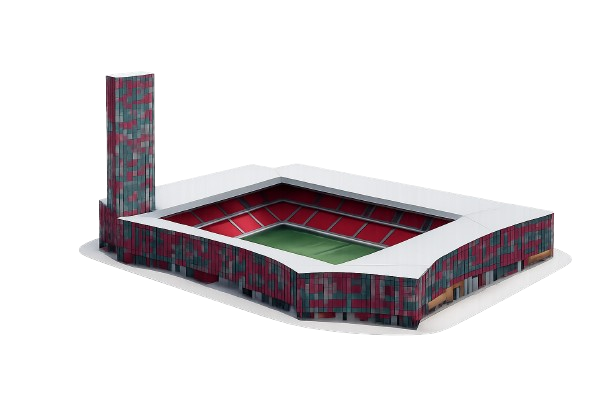
Arena Kombëtare is an all-seater, multifunctional football stadium located in Tirana, the capital of Albania. It was built on the site of the former “Qemal Stafa” Stadium and represents the largest football venue in the country. With a seating capacity of approximately 22,500 spectators, it serves as Albania’s premier sporting arena.
The stadium is jointly owned by the Albanian Football Association (FSHF) and the Albanian state through Kuq e Zi Sports Company Sh.A., an entity established specifically for the construction, management, and maintenance of the complex.
Designed by architect Marco Casamonti of Archea Associati, the stadium features a distinctive multi-faceted structure-an eight-sided square-where each façade provides access to different functions.
One corner of the complex is marked by a 112-meter-high tower rising 24 floors, housing hospitality and commercial spaces. Each façade organizes circulation flows according to use, clearly distinguishing between private areas such as the hotel tower, retail zones, and spectator access to the stadium.
In May 2022, Arena Kombëtare hosted the first-ever UEFA Europa Conference League final, contested between AS Roma and Feyenoord Rotterdam-an event of historic significance for Albanian football.
The official seating capacity of the stadium is 21,444 spectators.
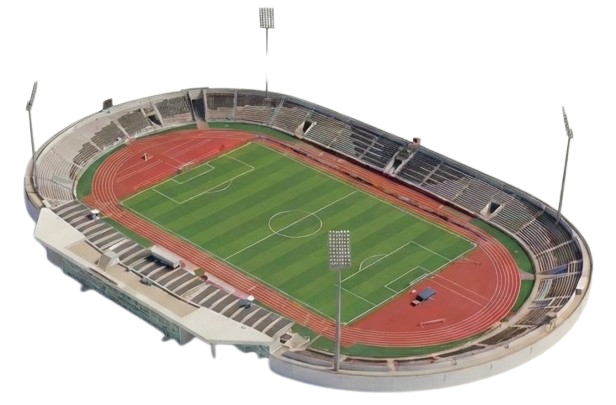
Elbasan Arena, formerly known as “Ruzhdi Bizhuta,” is a multifunctional stadium located in Elbasan, Albania. Completed in 1967, it has long served as the home ground of KF Elbasani.
History
The stadium was inaugurated in 1967 under the name Ruzhdi Bizhuta, honoring one of KF Elbasani’s most prominent players. Constructed during the 1960s, it replaced the club’s earlier field, which had become outdated and unsuitable for modern competition.
2014 Reconstruction
Before hosting international and domestic matches, Elbasan Arena underwent a comprehensive reconstruction, with investments exceeding €5.5 million. Renovation works began in February 2014 and were completed within seven months, in October of the same year, bringing the stadium fully in line with UEFA standards.
The stadium has a seating capacity of 12,509 spectators.
History
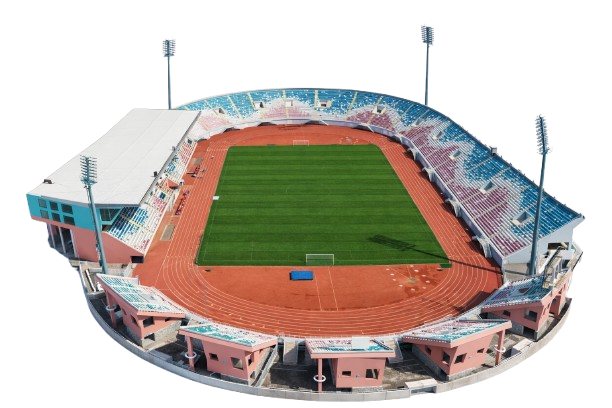
Construction of the stadium began on May 17, 1950, and it was inaugurated on May 1, 1952. Initially, it was named in honor of Vojo Kushi, an Albanian partisan and national hero.
In 1990, following the fall of communism in Albania, the stadium was renamed after Loro Boriçi (1922–1984), a renowned footballer and coach who played a pivotal role in the development of Albanian football.
Between 2015 and 2016, the stadium underwent a complete reconstruction, transforming it into a modern, all-seater venue with a capacity of 16,022 seats. It is currently the second-largest stadium in Albania.
International Matches
On March 29, 2003, the stadium hosted a UEFA Euro 2004 qualifying match between Albania and Russia, which concluded with a historic 3–1 victory for Albania.
The stadium’s current seating capacity is 15,934 spectators.
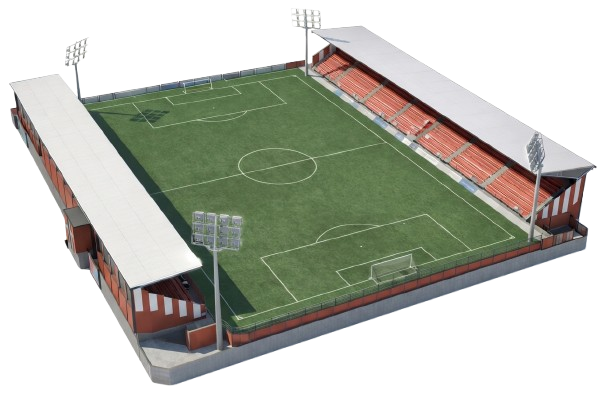
Arena e Demave is a modern, multifunctional football stadium located in the Tufinë area of Tirana, Albania. It serves as the main home ground, training center, and academy base for FK Partizani Tirana.
Completed in 2022, the stadium has a capacity of approximately 4,500 spectators and features an artificial playing surface along with two covered stands. It has been designed in compliance with UEFA and FIFA standards for both national league and international matches. Its name, translated as “Arena of the Bulls,” honors the long-standing mascot and nickname of Partizani-the bull-symbolizing the club’s strength and competitive spirit.
Situated on Myslym Keta Street, the stadium offers accessible facilities for fans and players, reinforcing community engagement at the heart of Partizani’s supporter base.
Since its opening, Arena e Demave has hosted Albanian Superliga matches and youth academy activities, contributing to the development of modern sports infrastructure in the Balkans, with a focus on both athletic performance and architectural innovation.
The stadium has an official seating capacity of 3,851 spectators.