
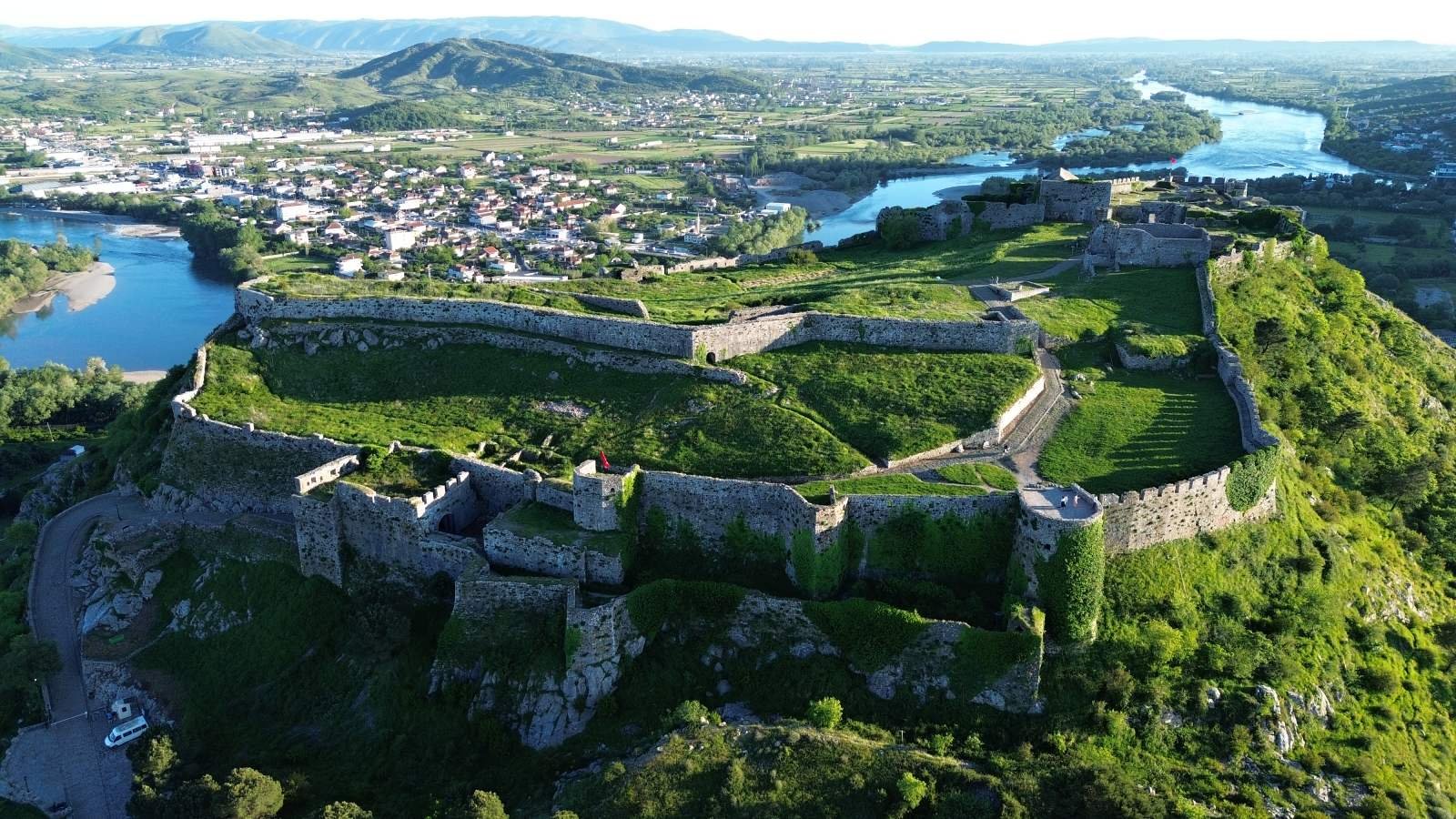
Rising on a rocky hill at the entrance to Shkodra, Rozafa Castle covers an area of about 9 hectares. In ancient times, its fortifications featured polygonal walls, traces of which can still be seen today. Originally an Illyrian fortified settlement, it is first mentioned during the reign of King Gent.
The historian Titus Livy described it as “the strongest place of the Labeates.”
The fortress became known as Rozafa in the Middle Ages, a period during which it was at times controlled by Slavs and Byzantines. Inside the walls are various structures, including military quarters, storage spaces, and an administrative building.
The castle is organized into three courtyards connected by gates. The third and smallest courtyard lies at the highest point of the hill, where rectangular openings replace towers along the outer walls.
Within this area are rooms connected to a round tower, a storage building, and a three-story structure dating from the Venetian period.
The second courtyard forms the central and largest section of the fortress and is separated from the first courtyard by a crosswall without towers.